Showing posts with label China. Show all posts

Monday, 28 December 2020

Another eleventh-century medieval Chinese coin found in England

A previous post discussed a find of a Northern Song dynasty Chinese coin from England whose context suggested that it may have been a genuine ancient loss from the medieval period, along with a variety of textual and archaeological evidence for contact between England and East Asia in the Middle Ages. The following post returns briefly to this question, noting the recent discovery of a second Northern Song dynasty coin from England. 

A copper-alloy Chinese coin of the Northern Song emperor Zhenzong, dated 1008–16, found near Petersfield, Hampshire (image: PAS).

The coin in question was issued between 1008 and 1016 during the reign of Emperor Zhenzong of the Northern Song dynasty and was found at Buriton, Hampshire, around 9 miles from the coast. As was the case with the other eleventh-century Chinese coin discussed here previously, the coin doesn't seem to be part of a 'suspicious' grouping of finds or deposited curated collection, and the field that it was recovered from has also produced a handful of medieval- and immediately post-medieval finds. These include a coin of King John minted at London in 1205–7, a medieval cut farthing of perhaps 1180–1247, two fragments of one or more medieval or early post-medieval vessels, and two mid-sixteenth-century coins. As such, it seems credible that this coin too could have been a medieval-era loss, and in this context it is worth noting that such Northern Song coins might quite credibly have arrived at any point up to perhaps the late fourteenth century, given that they continued to circulate in significant numbers well into that era. 

Looking more generally, the fact that we now have two, rather than one, eleventh-century Northern Song dynasty coins from England, both recovered from what seem to be medieval to early modern sites, adds weight to the case for considering them genuinely ancient losses. Interestingly, this find was also made only around 20 miles away from the only confirmed medieval imported Chinese pottery from England, a sherd of blue-and-white porcelain from a small cup or bowl that was found in a late fourteenth-century context at Lower Brook Street, Winchester. As to the wider context for these coins, the evidence for the presence of people who had, or who may have, travelled from East Asia in England during the thirteenth and fourteenth centuries was surveyed in the previous post, as was the evidence for people from Britain and Ireland in East Asia then. However, it is worth additionally drawing attention here to the 'global' distribution of medieval Chinese pottery and coins west of India, as mapped below, which demonstrates that finds of Chinese pottery and, to a lesser extent, coins outside of East Asia are by no means unknown.

With regard to the medieval Chinese pottery finds mapped below, substantial quantities have now been recognised from around the Indian Ocean coast and in both the Persian Gulf and Red Sea areas into northern Egypt. Archaeological finds of Chinese porcelain from Europe are much rarer, although definite examples are known from Winchester, Lucera (Italy) and Budapest (Hungary), along with a handful of surviving intact items that are believed to have entered Europe in the medieval era. The most famous of these are the so-called 'Marco Polo jar', a thirteenth- or fourteenth-century Chinese Qingbai porcelain jar found in the Treasury of San Marco in Venice, and the Gaignères-Fonthill vase, an early fourteenth-century Chinese Qingbai porcelain vase that was almost certainly present in Naples in the fifteenth century. In addition to these, there are a number of documentary references to Chinese pottery from medieval Europe. So, the 1323 will of Queen Maria of Naples and Sicily is believed to mention Chinese pottery, as does a 1363 inventory of property belonging to the Duke of Normandy and a 1379–80 inventory of Louis I, duke of Anjou. It also appears in, for example, a document from late fourteenth-century Genoa listing merchandise including porcelain, lustre ware and glass, and a 1456 inventory of the property of Piero di Cosimo de' Medici of Florence. As such, it seems clear that Chinese pottery was present in the households of the wealthiest people in Europe during the fourteenth and fifteenth centuries. Turning to the medieval Chinese coins mapped below, these are recorded much less frequently as archaeological finds and do not appear in documents from Europe at all, although this latter is hardly surprising. The only other certain find from Europe is a find of a tenth-century coin from Bulgaria, although a scattering are also recorded from East Africa, the Persian Gulf, the coast of Arabia, India, and Sri Lanka, suggesting that it is not impossible that a handful of examples might have made their way to Red Sea or Persian Gulf ports and then into Europe.

The distribution of archaeological and textual evidence for the presence of medieval Chinese pottery (black open circles) and coins (blue dots) west of India, set against the maximum extent of the Mongol Empire in the late thirteenth century in red; the map is based on Whitehouse 1972, Cribb and Potts 1996, Vigano 2011, Vigano 2014Zhao 2015Meicun and Zhang 2017Василев 2017 (image: Caitlin Green, drawn on a base map from Wikimedia Commons).

The content of this post and page, including any original illustrations, is Copyright © Caitlin R. Green, 2020, All Rights Reserved, and should not be used without permission.

Saturday, 31 March 2018

An eleventh-century Chinese coin in Britain and the evidence for East Asian contacts in the medieval period

This post is concerned with a rather curious and unique find of an eleventh-century Northern Song dynasty coin from China in Cheshire, looking first at its archaeological context before going on to explore the evidence for a degree of contact between people from East Asia and Britain in the medieval era, a topic that is of interest whatever the origins of this particular coin may be.

A Northern Song dynasty coin from China, minted during the Xining reign between 1068 and 1077, found in Cheshire; Click here for a larger version of this picture (image: PAS).

The coin in question was found in the Vale Royal area of Cheshire and has been identified by the British Museum as a cast copper alloy Chinese coin from the Northern Song dynasty (AD 960–1127), minted during the Xining reign period of Emperor Shenzong of Song between 1068 and 1077. Curiously, it appears to be a unique find from Britain—40 individual Chinese coins and one hoard are recorded on the Portable Antiquities Scheme, but only this eleventh-century example is of medieval date, with all of the other 146 Chinese coins being minted between the mid-seventeenth and early twentieth centuries. Needless to say, this coin has consequently been the subject of an understandable degree of scepticism, with the PAS record suggesting that it is 'doubtful that this is a genuine medieval find... more likely a more recent loss from an curated collection'. The aim of the following post is simply to ask whether it is at all possible that such a coin might have arrived in Britain during the medieval era, and, in doing so, review the evidence for contacts between East Asia and Britain in that period whatever our conclusion on this coin may be.

Looking first at the coin itself, recent losses or deliberate modern depositions of exotic finds are certainly encountered in Britain, including a group of 107 Chinese coins dated 1659 to 1850 found buried together at Barrow-in-Furness, Cumbria; another group of four coins from Foxhall, Suffolk; and a lovely Sasanian carnelian finger ring from East Sussex that was found with an odd collection of material of various dates including a modern replica of a Byzantine coin. Nonetheless, although the possibility of a loss from a curated collection certainly cannot be discounted, it can be perhaps overused as an explanation for 'surprising' finds—as Martin Biddle has observed, 'the proverbial absent-minded college don or cathedral canon, dropping items of his collection here, there and everywhere... has never seemed a very convincing character', and in recent years the hyper-scepticism over finds of at least some exotic coins in Britain has abated somewhat.(1) Given the above, it is worth looking at the local context of this medieval Chinese coin, to assess whether there are any positive reasons to believe it is part of such a 'suspicious' grouping of finds or deposited curated collection. The coin itself is one of a discrete group of 24 finds found in an area less than 100 metres in all directions from the findspot, and aside from the coin being considered here, none of these other finds appear especially 'suspicious' or exotic. They consist of two worn Roman coins (a common find across England, with 263,791 recorded on the PAS as of March 2018); two late medieval lead weights, two pieces of medieval copper-alloy casting waste, and two medieval or post-medieval weights; and fifteen post-medieval finds, dating from the sixteenth to early eighteenth centuries and ranging from coins of Elizabeth I to rings, trade weights and musket balls. All told, the post-Roman finds from the site suggest relatively unremarkable activity on the site from c. 1300 to c. 1750, with nothing else found that might hint at a deliberate exotic deposition or loss from a curated collection.

Looking more widely at the context of such a coin, whilst no other medieval Chinese coins are known from Britain, this find would not stand entirely alone as a medieval-era East Asian import to these islands if it is genuine, with two British sites having apparently produced such items from stratified contexts. One of these medieval imports is a sherd of Chinese blue-and-white porcelain from a small cup or bowl that was found in a late fourteenth-century context at Lower Brook Street, Winchester. The other import is a small piece of bronze with the character 藤 engraved upon it, possibly representing the name 藤原, Fujiwara, apparently found in a context of c. 1300 in the north bank of the Thames at London.(2) Of course, both finds are markedly later in date than the apparently eleventh-century coin found in Cheshire, as are the other finds from the site where the coin was discovered (c. 1300–1750) and, indeed, the other non-textile East Asian imports known from elsewhere in medieval Europe, such as the fragments of a small Chinese qingbai bowl that were recovered from a late thirteenth-century context in the medieval castle at Lucera, Italy.(3) However, this chronological difference is perhaps not such a major problem as might be assumed. Northern Song coins appear to have been minted in exceptional quantities and to have remained in circulation long after their initial minting date, so that in the fourteenth century around 88% of the coins both in circulation within China and exported outside of it seem to have been actually minted under the Northern Song dynasty (960–1126). As such, if the Northern Song coin from Cheshire is a genuine medieval import then it might quite credibly have arrived at any point up to perhaps the late fourteenth century, resolving the above issue.(4)

The Mongol Empire at its greatest extent in the late thirteenth century (image: Wikimedia Commons).

Such a potential thirteenth or fourteenth-century context for the arrival of an eleventh-century Chinese coin in Britain is not only supported by the archaeological evidence, but also by documentary sources. These texts make reference to both the presence of people from Britain and Ireland in East Asia and the presence of people who have, or may have, travelled from these regions in Britain during the thirteenth and fourteenth centuries. For example, the Flemish Franciscan missionary and explorer William of Rubruck (d. c. 1293) encountered a man of English origin whilst visiting Mongolia in 1254 AD. The man in question, named Basil, was living at Karakorum (near Kharkhorin, Mongolia), the capital of the Mongol Empire between 1235 and 1260, and is described as 'the son of an Englishman'; he is also probably the 'nephew of a bishop' that William later mentions that he met at Karakorum and who he states was captured by the Mongols at Belgrade.(5) Moreover, Basil is not the only Englishman known to have been living among the Mongols during the mid-thirteenth century. Ivo of Narbonne, for example, reported in a letter copied by Matthew Paris in his Chronica Majora that the 'prince of Dalmatia' captured eight fugitives in 1242 during the surprise withdrawal of the Mongols from Central Europe, just as they were at the gates of Vienna, and that these captives included 'an Englishman' who
had twice come as an envoy and interpreter from the king of Tattars to the king of Hungary, and plainly threatened and warned them of the evils which afterwards happened, unless he should give up himself and his kingdom to be subject to the Tattars.(6)
This English envoy of the Mongols (Tatars/'Tartars') was apparently an exile from England who had lost all he owned to gambling at Acre, Israel, and then wandered 'in a shameful state of want' further east into modern Iraq and beyond before the Mongols persuaded him to join them due to his apparent skill with languages, at which point he then travelled with them until he returned to Europe and was finally captured in Austria. Given that he had clearly travelled huge distances with the Mongols and, most especially, his role as envoy and interpreter for the Mongol khan, it seems possible that he was an earlier English visitor than Basil to the Mongol capital of Karakorum, Mongolia.

A detail from Andrea di Bonaiuto's fresco 'The Way of Salvation/The Church Militant and the Church Triumphant', c. 1365–8, with the figures at the centre identified by Jacques Paviot as an English knight of the Garter talking to a Mongol (Paviot, 2000, p. 318; Delvin, 1929); the fresco is located in the Spanish Chapel at Santa Maria Novella, Florence. Click here for a larger version of this image (image: Wikimedia Commons).

In addition to individual English people who were living amongst the Mongols on their own account or as slaves in the thirteenth century, there were also direct diplomatic contacts between Mongol rulers and the English then. Of particular note is the evidence for unidentified Mongol envoys ('Tartars') actually crossing the Channel to visit England in 1264, much to the apparent disgruntlement of the papal legate Guy Foulques—the future Pope Clement IV—who waiting in Boulogne for his own authorisation to cross!(7) Likewise, in 1287–8 the Turkic/Chinese Christian monk and diplomat Rabban Bar Sauma, originally from Beijing, China, visited Europe as an emissary of the Mongol Ilkhanate that stretched from Iraq to northern Afghanistan and met with King Edward I of England in Gascony:
And they went forth from that place, that is to say, from Paris, to go to the king of England, to Kasonia [Gascony]. And having arrived in twenty days at their city [Saint-Sever], the inhabitants of the city went forth to meet them, and they asked them, "Who are you?"And Rabban Sauma and his companions replied, "We are ambassadors, and we have come from beyond the eastern seas, and we are envoys of the King, and of the Patriarch, and the Kings of the Mongols."And the people made haste and went to the king and informed him [of their arrival], and the king welcomed them gladly, and the people introduced them into his presence. And those who were with Rabban Sauma straightway gave to the king the Pukdana [i.e. letter of authorisation] of King Arghun, and the gifts which he had sent to him, and the Letter of Mar Catholicus. And [King Edward] rejoiced greatly, and he was especially glad when Rabban Sauma talked about the matter of Jerusalem. And he said, "We the kings of these cities bear upon our bodies the sign of the Cross, and we have no subject of thought except this matter. And my mind is relieved on the subject about which I have been thinking, when I hear that King Arghun thinks as I think."And the king commanded Rabban Sauma to celebrate the Eucharist, and he performed the Glorious Mysteries; and the king and his officers of state stood up, and the king partook of the Sacrament, and made a great feast that day. 
Then Rabban Sauma said to the king, "We beseech you, O king, to give [your servants] in order to show us whatever churches and shrines there are in this country, so that when we go back to the Children of the East we may give them descriptions of them."And the king replied, "Thus shall you say to King Arghun and to all the Orientals: We have seen a thing than which there is nothing more wonderful, that is to say, that in the countries of the Franks there are not two Confessions of Faith, but only one Confession of Faith, namely, that which confesses Jesus Christ; and all the Christians confess it."And King Edward gave us many gifts and money for the expenses of the road.(8)
The route taken by Rabban Bar Sauma during his journey from Beijing to Gascony in the 1280s (image: Wikimedia Commons).

Yet another Mongol envoy named Buscarello de Ghizolfi, a Genoese adventurer who had settled in Persia, visited London in January 1290, accompanied by three squires who were probably themselves Mongols. Further envoys were sent from the Mongol Ilkhanate later that year, including a Mongol named Zagan and his nephew Gorgi, who were baptized by the Pope before being sent on to England on 2 December 1290 (accompanied again by Buscarello de Ghizolfi), and a certain Saabedin Archaon—a Nestorian cleric who had previously travelled to the west with Rabban Bar Sauma—who arrived after Zagan had left for England and who was, in turn, sent on with letters of credence in his favour addressed to Edward I by Pope Nicholas IV on 31 December.(9) Envoys were also dispatched in the opposite direction, with the regime at Acre sending the English Dominican friar David of Ashby eastwards in 1260 (he returned in 1274, accompanying the Mongol embassy that attended the Second Council of Lyon in that year) and King Edward I sending Geoffrey of Langley with Buscarello de Ghizolfi to the Mongol Ilkhanate capital of Tabriz, Iran, on a diplomatic mission in 1291.

In the early fourteenth century there is further evidence for direct diplomatic contact with both the Mongols and potentially China, which had been partly under Mongol control in the north since the first half of the thirteenth century and was ruled from 1271 by the Yuan Dynasty of China, founded by the Mongol ruler Kublai Khan. For example, in 1313 the royal household records for Edward II record a visit to England by an ambassador of 'the emperor of the Tartars', who Jacques Paviot suggests may have been representing the Great Khan in China, something perhaps supported by the fact that he was one William of Villeneuve.(10) This Franciscan missionary was one of seven suffragan bishops consecrated by Pope Clement V in 1307 to serve in the newly created archdiocese of Beijing, China (Khanbaliq), at the request of John of Montecorvino, the founder of the Chinese mission in the late thirteenth century. William is usually believed to have made it to India but to have then given up and not carried on to China with the others, instead returning to Italy, being next recorded at Avignon, France, in 1318.(11) However, this seems not to take account of the English record of his activities, which suggests that he returned to Europe as a Mongol envoy of 'the emperor of the Tartars' in 1313. Moreover, it is worth noting that Edward II sent a letter to the Emperor of China on 22 May 1313 in which he asks him to him to aid and protect the bishop William of Villeneuve, something that suggests that not only did William returned to Europe in 1313 as an envoy of the Great Khan in China, but also that he then aimed to return there.(12)

A fifteenth-century image of James of Ireland and Odoric of Pordenone in Sumatra, from BnF Français 2810, f.104r; click here for a larger version of this illustration (image: BnF).

In addition to the above, notice should also be made of the journey of James of Ireland, a cleric who travelled with Odoric of Pordenone to the east in the 1320s. Odoric's own account of the journey, written in 1330 after their return to Europe, indicates that they visited India, Sumatra, Java, and Champa (southern Vietnam), before arriving at Guangzhou, China, in 1323–4 and reaching Beijing in 1325, where they stayed for 3 years before travelling back home; Odoric died in 1331 at Udine, north-eastern Italy, and a present of 2 marks was subsequently paid to his companion, James of Ireland, according to the public books of Udine, who unfortunately then disappears from the pages of history.(13) Whether other subjects of the English king undertook similar journeys eastwards to Southeast Asia and China in the later thirteenth and fourteenth centuries is unrecorded, but it is by no means implausible that they did so. Certainly, we know of a number of European merchants who travelled to China at this time, from Marco Polo and Peter of Lucalongo in the late thirteenth century onwards, and there seem to have been communities of Genoese and Venetian merchants living in Yuan China during the fourteenth century, with Latin tombstones moreover known from Yangzhou and Zaiton (Quanzhou) in China. In this light, it is interesting to note that late medieval English coins have apparently been found in Vietnam.(14)

In conclusion, it may well be that this apparently eleventh-century Chinese coin from Cheshire is a modern loss from a curated collection, for example. However, given the lack of other 'exotic' items from the site where it was found, the possibility that it was actually a genuine medieval loss can perhaps be at least considered. Certainly, coins like this seem to have continued to circulate in significant numbers in China well into the fourteenth century, and in this light it is interesting that the other, largely unremarkable, post-Roman artefacts found at the site range in date from c. 1300–1750. Likewise, it is worth noting that there is, in fact, a small quantity of archaeological evidence for East Asian imports into thirteenth-/fourteenth-century England and, perhaps more importantly, a significant quantity of documentary evidence referring to both the presence of people from Britain and Ireland in East Asia and the presence of people who had, or who may have, travelled from these regions in England during the thirteenth and fourteenth centuries. In consequence, a potential context can be constructed for such a coin having arrived in England in c. 1300 or a little after, although this is—of course—not the same thing as saying that such an origin is by any means certain, especially whilst this coin remains a unique find in Britain.

The tombstone of Katerina Ilioni, daughter of the Genoese merchant Domenico Ilioni, dated 1342 and found at Yangzhou, China; click here for a larger version of this image (image: Wikimedia Commons).

Notes

1.     See, for example, M. Biddle, 'Ptolemaic coins from Winchester', Antiquity, 49 (1975), 213–15; S. Moorhead, 'Early Byzantine copper coins found in Britain – a review in light of new finds recorded with the Portable Antiquities Scheme', in O. Tekin (ed.), Ancient History, Numismatics and Epigraphy in the Mediterranean World (Istanbul, 2009), pp. 263–74; E. S. Georganteli, 'Byzantine coins', in M. Biddle (ed.), The Winchester Mint and Coins and Related Finds from the Excavations of 1961-71, Winchester Studies 8 (Oxford, 2012), pp. 669–78; and C. Morrisson, 'Byzantine coins in early medieval Britain: a Byzantinist's assessment', in R. Naismith et al (ed.), Early Medieval Monetary History: Studies in Memory of Mark Blackburn (London, 2014), pp. 207–42.
2.     D. Whitehouse, 'Chinese porcelain in medieval Europe', Medieval Archaeology, 16 (1972), 63–78 at p. 68; P. Ottaway, Winchester: Swithun’s ‘City of Happiness and Good Fortune’: An Archaeological Assessment (Oxford, 2017), online; M. Cooper, 'Cultural survey, 1991', Monumenta Nipponica, 47 (1992), 99–105 at p. 100. My thanks are due to Andrew West for drawing my attention to the London find.
3.     D. Whitehouse, 'Chinese porcelain in medieval Europe', Medieval Archaeology, 16 (1972), 63–78 at pp. 67–8.
4.     On the long life of Northern Song coins and their medieval export to Western Asia and East Africa, see J. Cribb & D. Potts, 'Chinese coin finds from Arabia and the Arabian Gulf', Arabian Archaeology and Epigraphy, 7 (1996), 108–18. Note, both coins and pottery seem to have been exported westwards from China in the medieval period, see for example Bing Zhao, 'Chinese-style ceramics in East Africa from the 9th to 16th century: A case of changing values ​​and symbols in the multi-partner global trade', Afriques, 6 (2015), online at http://journals.openedition.org/afriques/1836.
5.     W. W. Rockhill (trans.), The Journey of William of Rubruck to the Eastern Parts of the World, 1253–55 (London, 1900), pp. 211, 222–3.
6.     J. A. Giles (trans.), Matthew Paris's English History (London, 1889), vol. 1, pp. 470–1.
7.     J. Paviot, 'England and the Mongols (c. 1260–1330)', Journal of the Royal Asiatic Society, 10 (2000), 305–18 at p. 308.
8.     E. A. Wallis Budge (trans.), The Monks of Kublai Khan, Emperor of China; or, The History of the Life and Travels of Rabban Sawma (London, 1928), pp. 185–7, spelling slightly modernised and adjusted for consistency.
9.     J. Paviot, 'England and the Mongols (c. 1260–1330)', Journal of the Royal Asiatic Society, 10 (2000), 305–18 at pp. 314–5. The letters carried by Zagan and Saabedin are in the National Archives as SC 7/30/18 ('Commendation to Edward I of Andrew formerly called Zaganus, Buscarellus de Gisulfo and Moracius, envoys of Argon, king of the Tartars', 2 Dec 1290) and SC 7/31/16 ('Letters of credence to Edward I in favour of Saabedin Archaon, envoy of Argon, king of the Tartars', 31 Dec 1290); see also P. Jackson, The Mongols and the West 1221–1410 (London, 2005), p. 173, on Saabedin.
10.     J. Paviot, 'England and the Mongols (c. 1260–1330)', Journal of the Royal Asiatic Society, 10 (2000), 305–18 at p. 317; for the view that he was sent by the Middle Eastern Mongol il-khan, see for example J. R. S. Phillips, The Medieval Expansion of Europe, 2nd edn (Oxford, 1998), p. 129.
11.     J. B. Friedman & K. M. Figg (eds.), Trade, Travel, and Exploration in the Middle Ages: An Encyclopedia (London, 2000), pp. 22, 402, 403.
12.     T. Rymer (ed.), Foedera, Conventiones, Literæ, et Cujuscunque Generis Acta Publica, Inter Reges Angliæ et Alios Quosvis Imperatores, Reges, Pontifices, Principes, vel Communitates (London, 1739), vol. 2 pt. 1, p. 40 (22 May 1313), which is also discussed in K. Warner, Edward II: The Unconventional King (Stroud, 2014). Edward II also sent letters asking for aid to be given to William of Villeneuve to the emperor of Trebizond (Alexios II), the king of Georgia (Davit VIII), and the il-khan Oljeitu, suggesting the route that William of Villeneuve was intending on taking; a similar route was followed by Odoric of Pordenone in 1318, as related in his The Eastern Parts of the World Described (1330).
13.     Odoric of Pordenone, The Eastern Parts of the World Described, translated by H. Yule, Cathay and the Way Thither (London, 1913), vol. 2, pp. 97–267, and p. 11 for the gift to James of Ireland; J. B. Friedman & K. M. Figg (eds.), Trade, Travel, and Exploration in the Middle Ages: An Encyclopedia (London, 2000), p. 457.
14.     J. B. Friedman & K. M. Figg (eds.), Trade, Travel, and Exploration in the Middle Ages: An Encyclopedia (London, 2000), pp. 107–09, 372–4, 474, 663; L. Arnold, Princely Gifts & Papal Treasures: The Franciscan Mission to China & Its Influence on the Art of the West, 1250–1350 (San Francisco, 1999); J. Purtle, 'The Far Side: expatriate medieval art and its languages in Sino-Mongol China', in J. Caskey et al (eds.), Confronting the Borders of Medieval Art (Leiden, 2011), pp. 167–97; and J. Kermode, Medieval Merchants: York, Beverley and Hull in the Later Middle Ages (Cambridge, 1998), pp. 2–3 at fn. 10 for the claim that late medieval English coins have been found in Vietnam.

The content of this post and page, including any original illustrations, is Copyright © Caitlin R. Green, 2018, All Rights Reserved, and should not be used without permission.

Tuesday, 21 March 2017

A very long way from home: early Byzantine finds at the far ends of the world

The following brief post is once again offered largely for the sake of interest, being concerned with the furthest limits of the distribution of early Byzantine material in Eurasia and Africa. What follows consists of a distribution map of fifth- to seventh-century AD Byzantine finds and contemporary imitations accompanied by a brief discussion and illustration of some of the items that have been found in the far west, far east, far north and far south of the 'Old World'. Needless to say, the extensive distribution of early Byzantine material shown here is of interest for a number of reasons from the perspective of this blog, not least the light that it sheds on early medieval Britain's Byzantine and Indian Ocean imports and connections discussed in previous posts.

Distribution of early Byzantine items and contemporary imitations found outside of the boundaries of the mid-sixth-century empire, along with a depiction of the empire during the reign of Justinian (c. 565 AD). For a larger version of this map, click here. The numbers refer to sections in the text, below. Note, the finds in the Kama region of Russia seem to have arrived there in the eighth to twelfth centuries from Central Asia, hence the inclusion—following Mango (ed.), Byzantine Trade, 4th-12th Centuries (Farnham, 2009), fig. 1.1—of a notional grouping of finds in a regular block to the southeast of the Aral Sea and an arrow indicating the relationship between these and the Russian finds. (Image: C. R. Green, based on the sources listed in fn. 1)

The Far West (1)

For both St Jerome, writing near Bethlehem in 396, and Gildas, writing around a century later in late fifth- or early sixth-century Britain, the British Isles lay 'virtually at the end of the world towards the west and north-west'. Despite this, there was clearly an intriguing degree of contact between the British Isles and the early Byzantine empire during the fifth to seventh centuries, as has been discussed at length in a previous post. In terms of the material evidence for this connection, this is manifested by significant finds of fifth- to sixth-century Eastern Mediterranean and North African pottery in western Britain and Ireland (with around half of the total coming from the probable royal site of Tintagel, Cornwall), alongside Byzantine coins, metalwork, and a number of burials of people whose isotope results indicate that they could well have grown up in Byzantine North Africa. It has often been suggested that the material in the west may have arrived via a different mechanism to that in the east, perhaps representing direct, official contact via the Straits of Gibraltar and the Atlantic coast vs indirect transfer via merchants and elite exchange along the rivers of mainland Europe, although finds of late sixth- to early seventh-century Byzantine coins from the Anglo-Saxon royal site of Rendlesham, Suffolk, have recently been interpreted as evidence for 'direct mercantile contacts' with the Byzantine world in eastern Britain too.

A fifth- or sixth-century Late Roman 1 amphora from the Eastern Mediterranean found on the sea bed at Plymouth; note, this amphora still has the residue in it of the red wine that it once transported (image: Ships Project/ProMare, CC BY-NC-SA 2.0)

A rim-sherd of Phocaean Red Slip Ware—high quality red-slipped tableware made in modern Turkey during the late fifth to early sixth century—discovered at Collierstown, Co. Meath, Ireland (image: Kelly 2010, CC).

Byzantine bowls and spoons (with Greek inscriptions) from the Eastern Mediterranean, made c. 600 AD and found in the early seventh-century Sutton Hoo ship burial, Suffolk (image: British Museum).

The Wilton Cross, incorporating a Byzantine solidus of Heraclius dating 613–32; made at an East Anglian workshop in the first half of the seventh century and found at Wilton, Norfolk (image: British Museum).

A sixth- to seventh-century early Byzantine censer, found at Glastonbury Abbey; it was found with traces of burnt incense still remaining within it and the closest parallels for the Glastonbury censer come from Sardis (Turkey), Egypt and Galilee (image: British Museum).

The Far East (2, 3, 4)

If there is a substantial amount of early Byzantine material found in Britain and Ireland, the apparent westernmost extremity of the known world in late antiquity, there is also a notable quantity at the far eastern end too. In St Jerome's letter, cited above, the rhetorical opposite extremity of the world to Britain was given as India, but Roman and Byzantine authors were certainly aware of the existence of China and parts of Southeast Asia. China was, for example, mentioned by Roman and early Byzantine writers from the first century BC onwards and it is included not only in Ptolemy's second-century AD Geography (which mentions parts of Southeast Asia too), but also on the Tabula Peutingeriana, a fascinating map that seems to have had its origins in the Late Roman period. Moreover, Roman and especially Chinese sources make several references to Hellenistic, Roman and early Byzantine entertainers, merchants and/or embassies being present in China and Southeast Asia, including a mission in 166 AD that arrived via the south coast—probably entering China via Vietnam and claiming to have been sent by the Roman emperor Andun (Antoninus Pius or Marcus Aurelius Antoninus?), although this was perhaps really a commercial action that chose to represent itself this way—and numerous seventh- and eighth-century Byzantine embassies to Tang China.

In terms of the early Byzantine material found in eastern parts of Eurasia, there is a variety of surviving artefacts ranging from glass vessels, metalwork and textiles through to gold and bronze coinage, with the latter being by far the most numerous category. The most easterly early Byzantine artefacts are actually found in Korea and Japan ('2' on the map, above). The former has seen finds of glass vessels from the late fifth- to early sixth-century AD royal tombs at Silla, Korea, some of which appear to have actually been made in the early Byzantine empire and others of which are believed to be imitative of Late Roman/Early Byzantine forms, whilst in Japan there have been not only finds of early Byzantine 'Levantine 1' glass beads (probably made on the coast of present-day northern Israel) from fifth-century AD tombs, but the important mid-eighth-century AD imperial Shōsōin Repository at Nara, Japan, is also reported to contain a number of Byzantine items including a cushion cover made in early Byzantine Syria. Interestingly, neither Japan nor Korea is mentioned in Roman or Byzantine sources, although a recent isotopic and mitochondrial DNA study of burials on the Imperial estate at Vagnari, southern Italy, has indicated that one of the adults buried there in the first or second century AD could have had Japanese ancestry, given that 'all modern mtDNA matches to her available haplotype sequence are from Japan'.(2)

In addition to this material from the very far east, we also have a notable quantity of primarily sixth- to early seventh-century Byzantine gold coins and sixth- to eighth-century imitations from tombs in China, along with a number of finds of early Byzantine metalwork and glassware (and imitations of the same) from this country too. Both this material and that discussed in the preceding paragraph is often thought to have arrived via Central Asia along the 'Silk Road', especially given the presence of a number of similar finds in areas such as Uzbekistan and Tajikistan, although some of the Byzantine items found close to the Chinese coast and in Korea and Japan could have alternatively arrived by the less-discussed southern, maritime 'branch' of the Silk Road instead. Certainly, earlier Roman and Greek mariners made use of this route, and early Byzantine written sources moreover appear to make reference to it, whilst finds of fifth- to seventh-century Sasanian glassware in Japan are argued to have probably arrived there via the sea route. With regard to this maritime 'road', another relevant find may well be that of a probably sixth-century Byzantine lamp found in Thailand (marked as '3' on the map, above), and it is worth noting in this context that an East Javanese millefiori bead of sixth-century date has been found at the Byzantine Red Sea port of Berenike too (curiously, such beads are very rare indeed outside of East Java, with the only other concentration really being in the Silla tombs of Korea, mentioned above!).

Finally, thousands of fifth- to seventh-century Byzantine gold and bronze coins and imitations are known from India and Sri Lanka ('4' on the map), accompanied by fifth- to sixth-century amphorae on coastal and inland sites in western India. Such finds support the textual evidence for continued Indo-Roman trade and/or interaction via the Red Sea beyond the more frequently discussed Early Roman era into the Late Roman/Early Byzantine period, as do both the Indo-Pacific imports found at sites such as Byzantine Berenike and the recent isotopic analysis of burials of the fourth- to fifth-century AD at the Byzantine Red Sea port of Aila (Jordan), which indicates that people from areas beyond western Asia and North Africa were living there then, including some who had potentially grown up in the Indus Valley.
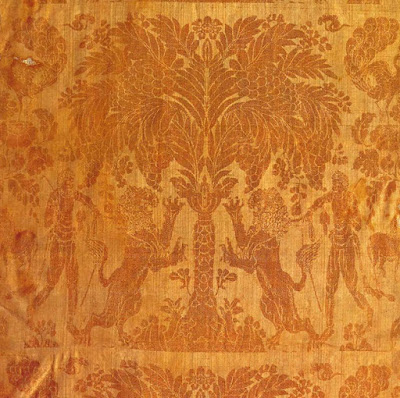
A silk cushion cover made in Byzantine Syria and preserved in the eighth-century imperial Shōsōin Repository at Nara, Japan, given to the monastery by the Emperor Shomu in 754; see H. B. Feltham, 'Lions, silks and silver: the influence of Sasanian Persia', Sino-Platonic Papers, 206 (2010), who notes that the cushion represents a copy of Sasanian motifs by 'the Byzantines in Syria' (p. 18). (Image via Pinterest; also in Feltham, 2010, fig, 10, CC)

Early Byzantine glass and imitations recovered from late fifth- to early sixth-century Silla tombs in Korea. (Image via Pinterest)

A gold imitation of a sixth-century Byzantine coin of Justinian I, struck on one side only, found in the Astana cemetery, China (image: British Museum). An example of a genuine Byzantine coin found in China is this mint gold Byzantine solidus of Anastasius (491–518), found in tomb of Emperor Jiemin (d. 532), Northern Wei dynasty.

A probably sixth-century Byzantine bronze lamp from Egypt, found at Pong Tuk, Thailand (image: scalar.usc.edu).

A copper-alloy coin of Justin II (565–78), found in southern India or Sri Lanka and collected by Colin Mackenzie in the early nineteenth century (image: British Museum).

The Far North (5)

Turning to the extremity of the world that St Jerome termed 'the frozen zone of the North', there is once again a number of interesting finds dating from the early Byzantine period. The most northerly material mapped here comes from northern Sweden, where a number of sixth- to seventh-century bronze Byzantine coins have been found as part of a wider trend of Hellenistic to early Byzantine coin finds in this region. These have been most recently studied by Zachrisson, who argues that they may well have arrived contemporaneously as part of the trade in northern fur products between Scandinavia and the Mediterranean world, and that they represent a phenomenon distinct from that which carried significant quantities of fifth- to mid-sixth-century Byzantine gold solidi and other material to the Baltic coast, islands and southern Scandinavia.

Looking east of the Baltic, there are other very northerly finds of early Byzantine material known from Estonia and Russia. The Estonian finds consist of two late fifth- to early sixth-century silver bowls discovered at Kriimani and Varnja in eastern Estonia; these are thought to be most probably direct imports from the south, rather than items that originally came to southern Scandinavia and were then transported eastwards, and can perhaps be once more associated with the fur trade or possibly the amber trade. The Russian finds come from the Kama region and consist of around two dozen pieces of early Byzantine silver plate, although in this case many of the finds come from features dating from the eighth to twelfth centuries AD, are found with Sasanian silver, and/or bear Sogdian, Chorasmian and other graffito. In light of this, it has been argued that these early Byzantine silver objects were originally transported to Central Asia before being subsequently re-exported to northern Russia.

The late fifth- to early sixth-century Byzantine bowl found at Kriimani, Estonia (image: Estonian Journal of Archaeology, CC BY-NC 4.0)

A gold solidus of the Byzantine emperor Anastasius (491–518) found on the Swedish island of Gotland (image: SHM, CC BY 2.5 SE).

An early seventh-century Byzantine silver gilded dish with Silenus and a Maenad; made in Constantinople, 613–629/30, with seals from the reign of Heraclius on the rear, and found in 1878 near Solikamsk, Perm, Russia (image: Internet Archive, Public Domain; a copyrighted colour photograph of this dish is available here).

The Far South (6, 7)

Looking finally to the lands of 'burning heat' to the far south of the early Byzantine empire, there are yet more intriguing finds to note. The first find is located almost on the Equator and comes from the middle of the Indian Ocean on the island of Gan, the largest island of the Maldives, where a cache of fifth- to sixth-century Byzantine gold coins were discovered in 1986 as part of investigations into a sixth-century and later Buddhist monastery located there. Needless to say, this stupa hoard should be almost certainly considered alongside the southern Indian and Sri Lankan finds discussed above. With regard to the Maldives, it is incidentally worth noting that there are references to people from these islands within the Roman empire in the fourth century AD from Ammianus Marcellinus and Philostorgios, and a passing mention seems to be made by Cosmas Indicopleustes in the sixth century, whilst Tang dynasty documents record two visits of Maldivians to China in the seventh century.

Even more southerly are the finds of early Byzantine materials made along the East African coast of Tanzania, well within the southern hemisphere (marked as '6' on the map). The earliest recorded finds from here are Byzantine coins of Justin I (518–27), Justinian I (527–65) and Heraclius (610–41) found on Pemba Island, part of the Zanzibar Archipelago, and the main coast opposite at Tanga. Although these coins have been subject of some scepticism, recent archaeological work on the Tanga coast offers a degree of support, indicating that there was probably long-distance trading taking place here in the pre-Islamic period and noting that this area is likely to be the location of the trading centre known to Graeco-Romans as Toniki. Even more significantly, excavations on Zanzibar island at the Unguja Ukuu site, just to the south of the Tanga coast, have revealed the presence of two pieces of early Byzantine fine ware pottery made in fifth- to early sixth-century Egypt and some probable early Byzantine glass from a level radiocarbon dated to c. 500 AD, whilst the north coast of Zanzibar has seen a find of fifth-century Byzantine amphorae sherds from the Fukuchani site. Moreover, further relevant finds been made a little way down the East African coast, close to the probable location of the southernmost 'metropolis' and trading port known to the Romans, Rhapta (mentioned by the Periplus and Ptolemy, and reportedly located in 2016 by divers off Mafia Island, Tanzania, who found the remains of five to six metre high walls associated with Roman-style ceramics and tile), including pieces of glassware that are comparable to examples from Fayum, Egypt, and were apparently made in sixth-century Syria, these having been recovered from a site at Kivinja that is radiocarbon dated to the fifth to sixth centuries AD.

Turning lastly to West Africa, recent work has again revealed evidence for the presence of probable early Byzantine material and contemporary imitations in the Sahara itself and also in parts of Sub-Saharan West Africa. The finds from within the Sahara are associated with the Garamantes, who made use of elaborate underground irrigation systems known as foggara in the Fezzan area of Libya in order to create a prosperous civilisation in the Sahara desert, including several small planned towns with a capital, Garama, that at its peak was home to around 4,000 people with a further 6,000 in surrounding satellite villages. Early Byzantine items recovered from here include fourth- to fifth-century AD glass vessels from the the heartland of the Garamantian kingdom—the Saharan oasis belt of the Wadi al-Ajal—which were made out of Egyptian HIMT glass, and part of a late sixth- or early seventh-century North African amphora recovered from the Garamantian fortified village of Aghram Nadharif in south-western Libya (a comparable example was excavated from early Byzantine Leptis Magna). Beyond the Sahara in Burkina Faso and Mali (marked as '7' on the map) there are yet more relevant items which presumably arrived in Sub-Saharan West Africa via the Garamantian kingdom. These include cowrie shells dated to the fifth to seventh century (which must have come from the Red Sea or further afield), carnelian and glass beads imported from both early Byzantine Egypt/the Levant and the Sasanian Middle East, and copper-alloy items of the fifth to seventh centuries made from metal that was imported from the Eastern Mediterranean and Britain, all recovered from a fourth- to seventh-century cemetery site at Kissi, Burkina Faso. Likewise, there have been finds of amphorae rims which seem to be imitative of North African amphorae of Late Roman/early Byzantine date (up to the seventh century) from three sites in Mali, to the west of Kissi, one from a context dated c. 450–600 AD.

A gold coin of the emperor Leo I (d. 474) found on Gan, the largest island of the Maldives; this is one of several fifth- to sixth-century Byzantine coins found in a container buried on a monastic site believed to have been established in the sixth century AD (image: NCLHR, reportedly Public Domain).

Ptolemy's map of East Africa from a fifteenth-century copy, with the 'metropolis' of Rhapta marked along with other trading sites along the east coast down to Tanzania that were known to the Romans (image: Wikimedia Commons).

A selection of beads found at Kissi, Burkina Faso. Carnelian beads like those shown here were found in the fifth- to seventh-century grave 10 at Kissi 3 and are believed to have been manufactured in the Byzantine Near East/Egypt; chemical analysis of the glass beads indicates that they were made using glass from the Near and Middle East, with the majority actually being made within the Sasanian Empire. (Image: B. Voss/Afriques, CC)

Notes

1.     The map included here is based on M. M. Mango (ed.), Byzantine Trade, 4th-12th Centuries: The Archaeology of Local, Regional and International Trade (Farnham, 2009), figs. 1.1 and 15.4, with a significant number of modifications and additions. Sources utilised include the following: K. C. MacDonald, 'A view from the South: sub-Saharan evidence for contacts between North Africa, Mauritania and the Niger, 1000 BC–AD 700', in A. Dowler & E. R. Galvin, Money, Trade and Trade Routes in Pre-Islamic North Africa (London, 2011), pp. 72–82; S. Magnavita, 'Initial encounters: seeking traces of ancient trade connections between West Africa and the wider world', Afriques, 4 (2013), online at https://afriques.revues.org/1145; S. Magnavita, 'Sahelian crossroads: some aspects on the Iron Age sites of Kissi, Burkina Faso', in S. Magnavita et al (eds.), Crossroads / Carrefour Sahel: Cultural and Technological Developments in First Millennium BC/AD West Africa (Frankfurt, 2009), pp. 79–104; T. R. Fenn et al, 'Contacts between West Africa and Roman North Africa: archaeometallurgical results from Kissi, northeastern Burkina Faso', in S. Magnavita et al (eds.), Crossroads / Carrefour Sahel, pp. 119–46; C. N. Duckworth, 'From the Mediterranean to the Libyan Sahara: chemical analyses of Garamantian glass', Journal of Archaeological Science: Reports, 7 (2015), 633–9 at p. 635; M. Liverani (ed.), Aghram Nadharif: the Barkat Oasis (Sha'abiya of Ghat, Libyan Sahara) in Garamantian Times. The Archaeology of Libyan Sahara, Volume II (Firenze, 2005), pp. 242, 248, 368 ; R. R. Darley, Indo-Byzantine Exchange, 4th to 7th Centuries: a Global History (University of Birmingham PhD Thesis, 2013); N. Mohamed, 'Maldivian seafaring in the pre-Portuguese period', National Centre for Linguistic and Historical Research, Republic of Maldives (2005), online at http://qaumiyyath.gov.mv/docs/whitepapers/history/seafaring.pdf; S. Moorhead, 'Early Byzantine copper coins found in Britain – a review in light of new finds recorded with the Portable Antiquities Scheme', in O. Tekin (ed.), Ancient History, Numismatics and Epigraphy in the Mediterranean World (Istanbul, 2009), pp. 263–74; A. I. Zachrisson, 'Vittnesbörd om pälshandel? Ett arkeologiskt perspektiv på romerska bronsmynt funna i norra Sverige', Fornvännen, 105 (2010), 187–202; R. Hobbs, Late Roman Precious Metal Deposits, c. AD 200-700: Changes Over Time and Space (University of London PhD Thesis, 1997); P. Somogyi, 'New remarks on the flow of Byzantine coins in Avaria and Walachia during the second half of the seventh century', in F. Curta & R. Kovalev (eds.), The Other Europe in the Middle Ages: Avars, Bulgars, Khazars and Cumans (Leiden, 2008), pp. 83–149; F. Curta & A. Gândilă, 'Hoards and hoarding patterns in the Early Byzantine Balkans', Dumbarton Oaks Papers, 65–66 (2011–2012), 45–111; E. Stolyarik, Essays on Monetary Circulation in the North Western Black Sea Region in the Late Roman and Byzantine Periods (Odessa, 1993); H. Horsnaes, 'Late Roman and Byzantine coins found in Denmark', in M. Wołoszyn (ed.), Byzantine Coins in Central Europe between the 5th and the 10th century (Krakow, 2009), pp. 231–70; M. Woloszyn, 'Byzantine coins from the 6th and the 7th c. from Poland and their East–Central European context. Ways and phases, context and function', in A. Bursche et al (eds.), Roman Coins outside the Empire. Ways and Phases, Context and Function (Wetteren, 2008), pp. 195–224; D. Quast & U. Tamla, 'Two fifth century AD Byzantine silver bowls from Estonia', Estonian Journal of Archaeology, 14 (2010), 99–122; A. Naymark, Sogdiana, its Christians and Byzantium: a Study of Artistic and Cultural Connections in Late Antiquity and Early Middle Ages (Indiana University PhD Thesis, 2001); R. Hobbs, 'Roman coins from Merv, Turkmenistan', Oxford Journal of Archaeology, 14 (1995), 97–102; Lin Ying, 'Solidi in China and monetary culture along the Silk Road', The Silk Road, 3.2 (2005), 16–20; J. Drauschke, '"Byzantine" and "oriental" imports in the Merovingian Empire from the second half of the fifth to the beginning of the eighth century', in A. Harris (ed.), Incipient Globalisation? Long-Distance Contacts in the Sixth Century (Oxford, 2007), pp. 53–73; P. Bartlett et al, 'The Byzantine gold coinage of Spania (Justinian I to Heraclius)', Revue Numismatique, 6 (2011), 351–401; B. Ager, 'Byzantine influences on Visigothic jewellery', in C. Entwistle and N. Adams (eds.), Intelligible Beauty: Recent Research on Byzantine Jewellery (London, 2010), pp. 72–82; B. M. Serrano, 'Old and new coins in Southern Hispania in the 6th century AD', in J. Chameroy & P-M. Guihard, Produktion und Recyceln von Münzen in der Spätantike (Mainz, 2016), pp. 139–53; C. Morrisson, 'Regio dives in omnibus bonis ornata: the African economy from the Vandals to the Arab conquest in the light of coin evidence', in S. T. Stevens & J. P. Conant (eds.), North Africa under Byzantium and Early Islam (Washington, D.C., 2016), pp. 173–98; C. Kwangshik, 'Silla Art and the Silk Road', International Journal of Korean History, 19 (2014), 1–22; S. Lee & D. P. Leidy, Silla: Korea's Golden Kingdom (New York, 2013); B. Borrell, 'The early Byzantine lamp from Pong Tuk', Journal of the Siam Society, 96 (2008), 1–26; H. Feltham, 'Lions, silks and silver: the influence of Sasanian Persia', Sino-Platonic Papers, 206 (2010), 1–51; N. Chittick, 'Six early coins from near Tanga', Azania, 1 (1966), 156–7; C. Ntandu, 'The find of ancient trade materials on the northern coast of Tanzania', online at academia.edu; N. Boivin et al, 'East Africa and Madagascar in the Indian Ocean world', Journal of World Prehistory, 26 (2013), 213–81; A. M. Juma, 'The Swahili and the Mediterranean worlds: pottery of the late Roman period from Zanzibar', Antiquity, 70 (1996), 148–54; A. Juma, Unguja Ukuu on Zanzibar: an Archaeological Study of Early Urbanism (Uppsala, 2004); F. A. Chami, 'The Early Iron Age on Mafia Island and its relationship with the mainland', Azania, 34 (1999), 1–10; D. T. Potts, 'The circulation of foreign coins within Arabia and Arabian coins outside the Peninsula in the pre-Islamic era', in M. Huth and P. G. van Alfen (eds.), Coinage of the Caravan Kingdoms (New York, 2010), 65–82; T. Power, The Red Sea from Byzantium to the Caliphate: AD 500–1000 (Oxford, 2012); G. Duby, Map of 'L'empire byzantin à l'avènement de Justinien I (527 EC) et à sa mort (565 EC)', Grand Atlas Historique (Larousse, 1995–2004), available on Wikimedia Commons, with slight modifications.
2.     T. L. Prowse et al, 'Stable isotope and mitochondrial DNA evidence for geographic origins on a Roman estate at Vagnari (Italy)', in H. Eckardt (ed.), Roman Diasporas: Arachaeological Approaches to Mobility and Diversity in the Roman Empire (Portsmouth RI, 2010), pp. 175–97 at pp. 186, 189, 191, quotation at pp. 189–91; T. L. Prowse, 'Isotopes and mobility in the ancient Roman world', in L. de Ligt & L. E. Tacoma (eds.), Migration and Mobility in the Early Roman Empire (Leiden, 2016), pp. 205–34 at p. 194.

The content of this post and page, including any original illustrations, is Copyright © Caitlin R. Green, 2017, All Rights Reserved, and should not be used without permission.