
A previous post on here listed a number of field and other local minor names from Lindsey that made reference to folkloric and monstrous creatures inhabiting northern Lincolnshire; the aim of the following brief discussion is to offer some further names of the same type, based this time on the Place-Names of Lincolnshire, volumes 1–7. Once again, it should be noted that the majority of these names derive from medieval and early modern sources and suggest the existence of local folklore and tales, long since lost, focused on the pits, mires, fields, pools and mounds of the pre-Modern Lincolnshire landscape.
 |
| J. R. Skelton's 1908 illustration of Grendel, who is described as a þyrs/thyrs in Beowulf (image: Wikimedia Commons, Public Domain). |
Old Norse þurs (thurs)/Old English þyrs (thyrs)—a giant, a monster/ogre/demon
A word indicating a giant or similar monster with a dangerous or destructive nature; most famously found in the Old Norse compound hrímþursar, the 'frost giants', and as a description of Grendel in line 426 of the Old English poem Beowulf. It seems to indicate a malevolent, fen-dwelling monster of the Grendel type, with the Old English Maxims II saying that þyrs sceal on fenne gewunian ana innan lande, 'the þyrs (giant, ogre) shall dwell in the fen, alone in his realm'; compare the Thrusmyre in Edlington parish, 'a mire, Old Norse myrr, inhabited by a þurs'. The names below imply a number of features thought to be either inhabited by—or made by—such creatures in the medieval/early modern Lincolnshire landscape; note, the dates indicate the year in which the name is first documented.
- Thirsewell, Thorsey Nab, Glentham (1220)—'spring haunted by giants', sometimes with nabbi, 'hill/knoll'.
- Thyrstpit, Usselby (1372)—'giant-pit' or 'demon-haunted pit'; note, the compound þyrspyt etc is first recorded in a ninth-century Old English charter.
- Thurspits, Bottesford (1679)—'the pits, hollows haunted by giants, demons or goblins'.
- Low Thrush pits/Upper thrushpit, Ashby near Scunthorpe (1750)—'the pit/hollow haunted by a demon or giant' or 'giant-pit'.
- Trusdall, Nettleton (1577)—'the share of land haunted by a demon or giant'.
- Tursfeild Crosse, Scawby (1669)—'the field haunted by demons, giants or goblins' + cros, 'cross'.
- Threshole, Saxilby and Ingleby (1766)—'the hollow occupied by a giant or demon'. Note, Bishop White Kennett, in a glossary written in c. 1700, defines a 'Thurs-house or Thurs-hole' as 'a hollow vault... looked on as enchanted holes'.
- Thirspitts, Waltham (1601)—'the pit occupied by a giant or demon'.
- Thuswelle closes, Hemswell (1670)—'spring haunted by a giant or demon'.
 |
| Image from the title page of 'Robin Goodfellow: His Mad Pranks and Merry Jests' (1629); Robin Goodfellow is generally considered a type of hob or hobgoblin (image: Wikimedia Commons, Public Domain). |
Middle English hob(be)—a mischievous spirit/hobgoblinA word for a mischievous spirit or goblin; a hob in Northern and Midland English folklore was a rough, hairy, creature of the 'brownie' type, whose work could bring prosperity to farms but who could become mischievous or dangerous if annoyed. Household variants might be given new clothes to get them to leave forever, although other hobs lived outside in caves or holes. The normal form in Northern and North Midland counties was apparently Hobthrus or Hobthrust, which is a compound of Middle English hob(be), 'a hobgoblin', and thurs(e), 'a devil, evil spirit', from OE þyrs/ON þurs, 'a giant, monster'; note, Dickins considers hob to be in fact an abbreviation of hobthrus, with the latter being the original form and the hob as a creature thus being a less-malevolent development of the Old Norse þurs (thurs)/Old English þyrs (thyrs).
- Hob Lane, East Halton (1804)—'a lane haunted by a hobgoblin'; see also the Hoblurke recorded at East Halton in the 1200s in the previous post. A tale of a hobthurst (hob + thurs) from East Halton was collected by Mabel Peacock around the turn of the nineteenth century, when it was apparently living in the cellar of Manor Farm in an iron pot and was described as 'a kind of devil' and 'a little fellow with a big head'. He would apparently help the farmer on occasion, for example driving sheep to the barn so that they could be sheared, although he was also mischievous and once left the wagon on top of the barn; the farmer was meant to leave the hobthrust a linen shirt for his help each year, but when he gave the creature a hempen shirt one year instead, the hobthrust set up an angry wail and refused to ever help on the farm again.
- Hobbing hole, Lissingleys in Buslingthorpe parish (1846)—'hollow frequented by a hobgoblin', presumably somewhere on the ancient medieval common pasturage and meeting-place of Lissingleys, now in Buslingthorpe parish but before 1851 an extra-parochial area shared between the surrounding parishes.
- Hobthrust Dale, Burton-upon-Stather (1698)—'the share of land haunted by a hob-thrust, a goblin', with hob-thrust as above.
- Hobtrust Lane, Goxhill (1775)—another name involving the compound hobthrust < hob(be) + thurs(e). Note, Goxhill is a neighbouring village to East Halton, above.
 |
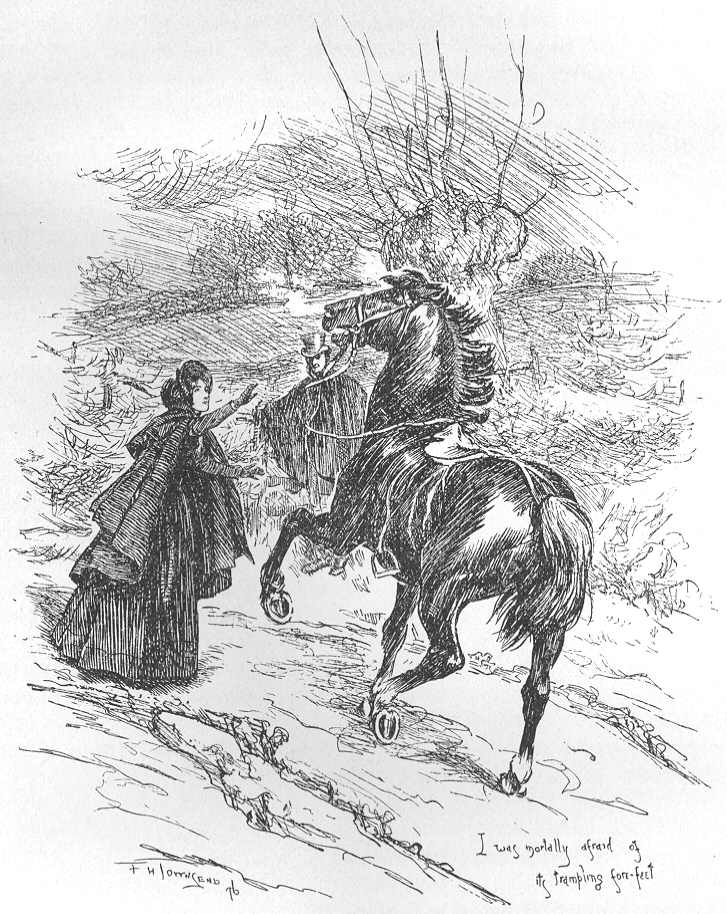
| Jane Eyre encountering Mr Rochester's horse, which she at first mistakes for a Gytrash, a Northern English variant of the 'shag foal' (image: Wikimedia Commons/Project Gutenberg, Public Domain). |
The 'Shag Foal'—a rough-coated goblin horse
- Shag Foal, Ulceby in North Lincolnshire (1826)—a piece of land haunted by a 'shag foal'.
 |
| The road from Roxby to Winterton Cliff House in 1898, showing the position of Roxby Mill; this was presumably known as Boggart Lane in the 1830s, where a 'shag foal' was seen by a young man as he passed Roxby Mill (image: David Rumsey). |
Boggarts'Boggart' was a general northern term for a frightening creature that might be a ghost, malicious fairy or minor demon, with outdoor boggarts generally haunting pits, wells or lonely lanes.
- Bogger Furlong, Caistor (1649)—a furlong in the old open field that was haunted by a boggart.
- Boggart Lane, Roxby (1830s)—the boggart haunting this lane, also known as Goosey Lane, may be identical with the 'shag foal' met by a young man as he passed Roxby Mill, which was 'sum'ate as big as a watter-tub' and 'a gret shagg'd thing', with huge eyes; it 'shooved him roond wheniver he tried to slip past it'.
 |
| J. R. Skelton's 1908 illustration of the slave in Beowulf who stole the dragon's golden cup, thinking to redeem himself, and thus awoke the dragon (image: Wikimedia Commons). |
Dragons, trolls, elves & other creatures
- Drakehou, drackhole, Owmby by Spital (1330)—probably the hollow inhabited by a dragon, although the earliest form has the second element Old Norse haugr, 'mound, barrow', which would fit with other early-recorded dragons; as the Old English Maxims II puts it, Draca sceal on hlæw, frod, frætwum wlanc, 'A dragon belongs in a mound, old and proud of treasures', and compare Drakelow, Derbyshire, æt Dracan hlawen in 942, which is Old English dracan hlāw, 'the dragon's mound'.
- Drakehord, Nettleham (1348–9)—Old English dracanhord, 'dragon's hoard'; see above.
- Draykmoor, Tetney (1764)—Middle English drāke, 'a dragon', + mōr, 'a marsh'.
- Poke Close, Willoughton (1554)—'the goblin infested enclosure', pūca, compare 'Puck of Pook's Hill'.
- Trolleheudland, Goxhill (1309)—'the headland (place where the plough turned) haunted by a troll'.
- Aluehou, Tetney (12th century)—a Scandinavian name meaning 'the mound, haugr, haunted by elves',
- Scrittecroft, Scothern (1216–72)—'croft, small field' + scritta, probably with the sense 'devil, wizard', cf. ON skratti.
- Grimesdic, Dunholme (1154–89)—'Grim's ditch', with reference to the Óðinn-name Grímr used as a synonym for the devil.
- Grimeshow, Nettleham (1348–9)—'Grim's mound/barrow, ON haugr', with reference to the Óðinn-name Grímr used as a synonym for the devil.
The content of this post and page, including any original illustrations, is Copyright © Caitlin R. Green, 2020, All Rights Reserved, and should not be used without permission.


2.jpg)